Provided presets¶
Read-only, repo/CI-sourced UI-settings presets — separate from the local presets a user saves in their own browser. A source (typically a owner/repo GitHub repository) publishes a bundle; every visitor to the dashboard sees the same catalog under a PROVIDED section of the presets popover, with Apply and Clone-to-edit actions. Nothing is written back — provided presets are never edited or deleted from the UI.
Full contract: OpenAPI spec (presets tag) · API_SPECIFICATION.md (provided_presets) · Fetcher spec § Preset discovery.
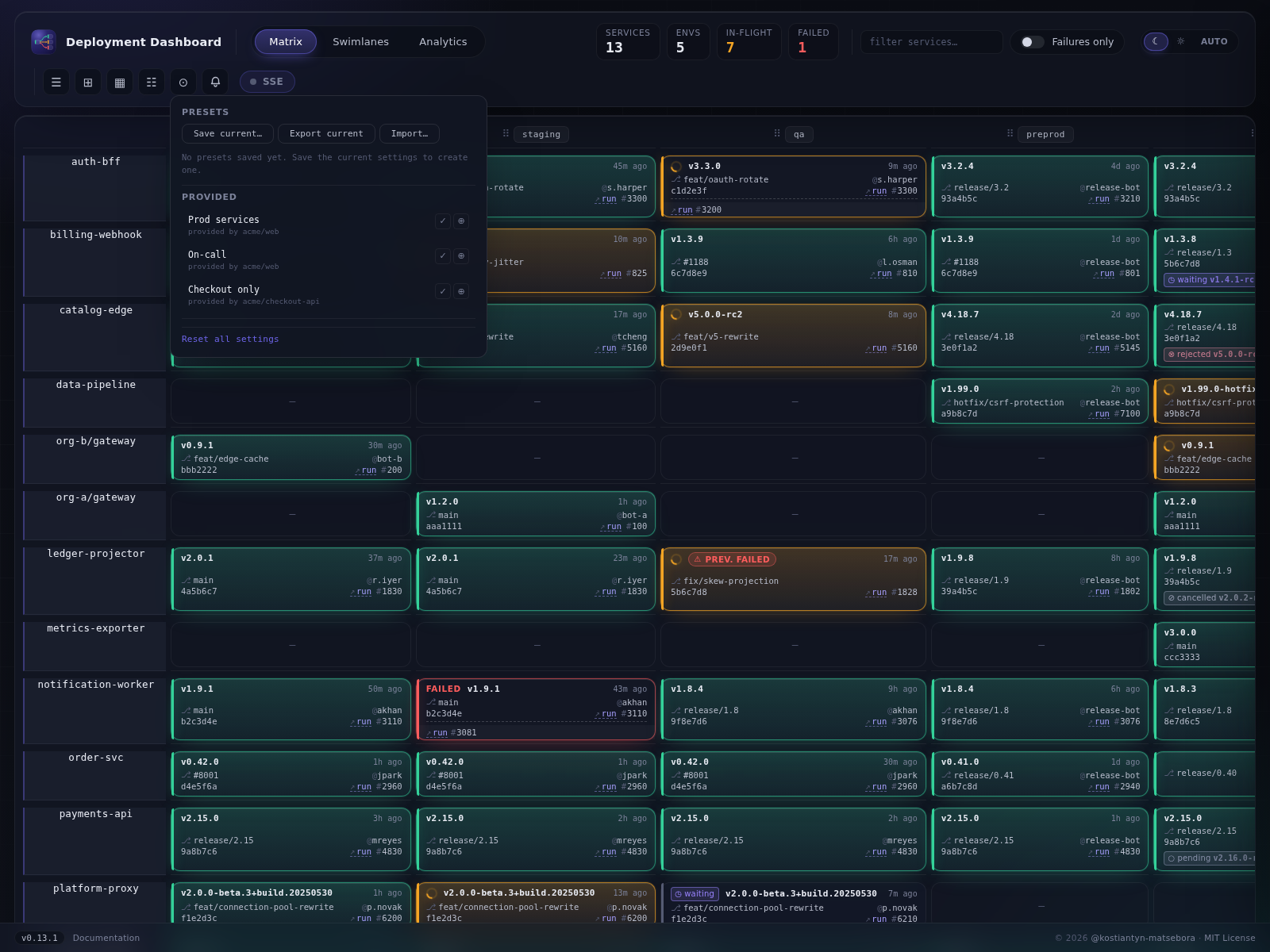
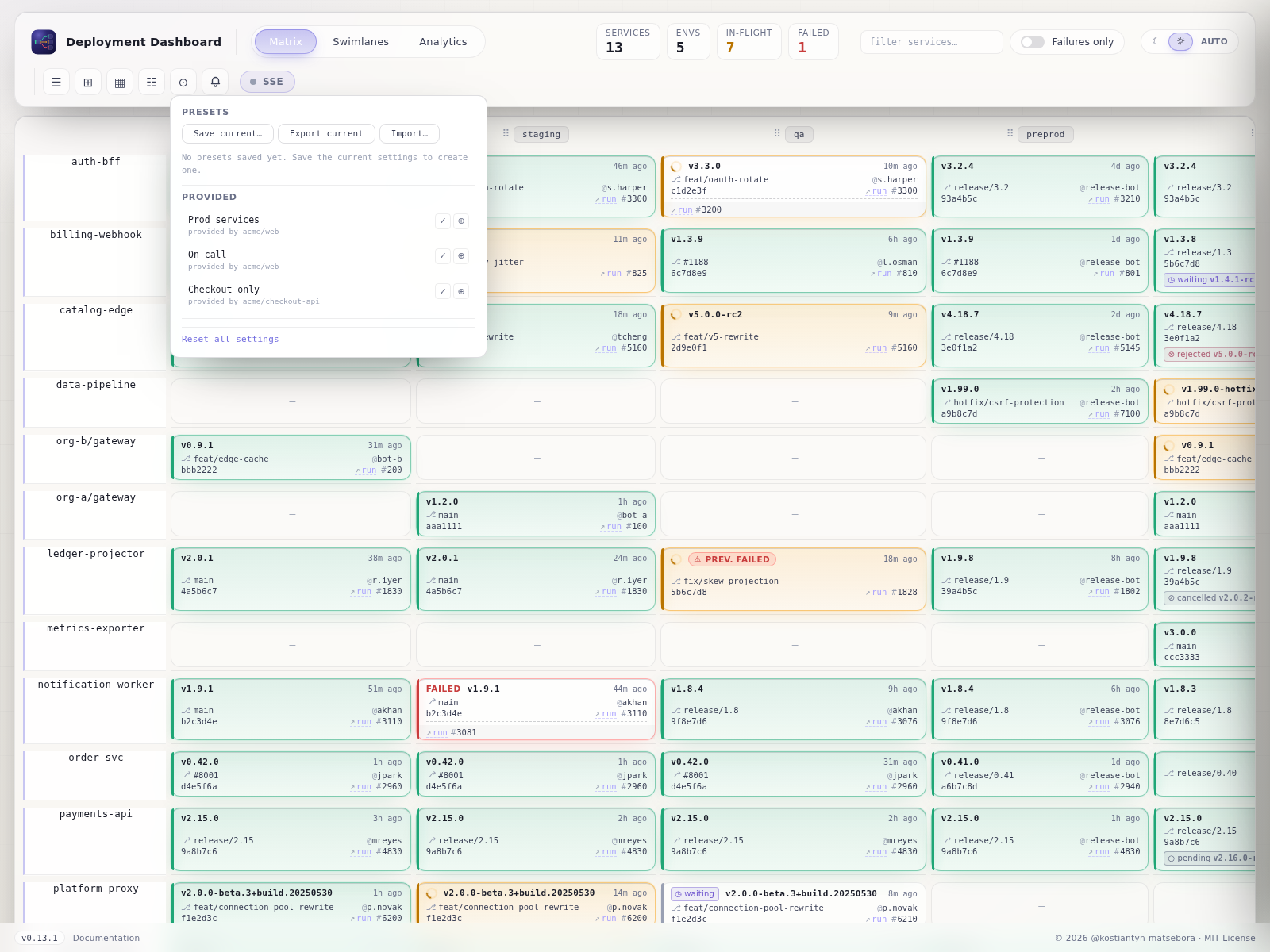
The .deployment-dashboard/*.json convention¶
A source publishes presets by committing JSON files under a .deployment-dashboard/ directory at the repo root. Each *.json file is single-or-bundle — either shape is valid:
Single envelope — one preset per file:
{
  "version": 1,
  "name": "Prod services",
  "settings": { "theme": "dark", "view": "matrix", "failOnly": true }
}
Bundle — multiple presets in one file:
{
  "version": 1,
  "presets": [
    { "version": 1, "name": "Prod services", "settings": { "theme": "dark", "view": "matrix" } },
    { "version": 1, "name": "On-call",       "settings": { "theme": "dark", "view": "swimlanes" } }
  ]
}
settings is opaque — the backend stores it verbatim; it is the same shape a local preset's settings field carries (see What a preset saves). Any number of .json files may live in the directory; non-.json files and sub-directories are ignored. All presets across every file in the directory are aggregated into one bundle per source.
Publishing presets (push mode)¶
Any process that can make an HTTP call can publish, independent of the Fetcher:
curl -fsS -X PUT "$DASHBOARD_URL/api/presets/sources/acme/web" \
  -H "X-Api-Key: $DASHBOARD_API_KEY" \
  -H "Content-Type: application/json" \
  -d '{
    "version": 1,
    "presets": [
      { "version": 1, "name": "Prod services", "settings": { "theme": "dark", "view": "matrix" } }
    ]
  }'
{source}is the repo'sowner/repo(it contains a slash — the API matches it with a catch-all route).- The body is a
PresetBundle— same shape as the bundle file above. - Request body capped at 256 KiB; larger bodies get
413. 204 No Contenton success;401ifX-Api-Keyis missing/invalid.- No Fetcher, no
Contents:read, no GitHub token at all is involved. A CI job step (GitHub Actions, Azure DevOps, GitLab CI, Jenkins — same "any pipeline can call a URL" pattern as deployment events) can PUT the bundle directly whenever.deployment-dashboard/*.jsonchanges.
Automatic discovery (pull mode)¶
When the Fetcher runs with Contents:read granted, it polls each configured GITHUB_REPOS entry's .deployment-dashboard directory on its own slow cadence (DISCOVERY_INTERVAL_SECONDS, default 3600s) and PUTs the aggregated bundle automatically — no manual curl needed. See Fetcher spec § Preset discovery for the mechanics (ETag-conditional directory read, single-or-bundle parsing, rate-limit budget).
Three permission tiers¶
| Tier | Setup | What happens |
|---|---|---|
| Push-only | No Fetcher deployed (or deployed without reading this repo) | Zero GitHub read for presets. CI publishes bundles directly via the curl PUT recipe above whenever .deployment-dashboard/*.json changes. |
Pull, without Contents:read |
Fetcher runs in pull mode; GITHUB_TOKEN has Deployments:read + Actions:read only (the minimal tier) |
Deployment ingest works normally, but preset discovery is skipped for that token — the directory-listing call needs Contents:read. Presets for this repo still require the push-mode recipe. |
Pull, with Contents:read |
Fetcher runs in pull mode; GITHUB_TOKEN has the full tier (+ Contents: Read-only, opt-in) |
Fully automatic — the same Contents:read grant that unlocks explicit Swimlanes parent edges also unlocks preset discovery. No curl needed; commits to .deployment-dashboard/*.json are picked up within DISCOVERY_INTERVAL_SECONDS. |
Grant-once-to-bootstrap-then-revoke. Contents:read only needs to be present at the moment a discovery cycle runs. An adopter can grant it temporarily, let one discovery cycle publish the bundle, then revoke it — the published presets are unaffected by the revoke; see the keep-last-known-good semantics below.
Replace-by-source and keep-last-known-good¶
Each PUT /api/presets/sources/{source} — whether from a CI curl step or the Fetcher — is authoritative-replace: it replaces every preset previously published by that source. An empty presets: [] is a valid, deliberate authoritative-empty bundle that prunes all of that source's presets.
Prune only ever follows a successful, authoritative read. For Fetcher-driven discovery specifically:
| Directory-listing outcome | Effect |
|---|---|
200, one or more valid .json files |
Replace — publish the aggregated bundle for the source. |
200, zero .json files (empty directory) |
Replace with an empty bundle — prunes every preset previously published by this source. |
304 Not Modified (ETag match) |
No-op — reuses the last-published bundle, no re-PUT. |
403, 404, any other non-2xx, a per-file fetch/parse error, or a network failure |
Skip the whole source for this cycle — never prune, never publish a partial bundle. The dashboard keeps whatever that source last successfully published. |
This is why revoking Contents:read after a bootstrap PUT is safe: the next discovery cycle gets a 403 on the directory listing, which is a skip, not a prune — the previously-published presets remain untouched until either Contents:read is re-granted or a push-mode curl PUT replaces them explicitly.
See also¶
- UI settings & presets — the local, per-browser preset feature this complements.
- Configuration — Fetcher —
DISCOVERY_INTERVAL_SECONDSand GitHub token permission tiers. - Fetcher spec § Preset discovery — full mechanics.