Built by Claude
Zero to hero: one person and an AI engineering team took a half-page brief to a shipping product — the Deployment Dashboard — a working MVP in 3 days.
The goal
A complete product — the Deployment Dashboard — produced by AI end-to-end: code, automation, docs, tests, delivery. The human only sets direction and signs off.
Two achievements in one project
-
A method — an AI engineering team
A reusable process: specialist roles, AI agents, and enforced guardrails. The reusable asset.
-
A product — built entirely by it
A real deployment dashboard, shipped end-to-end with one human steering. The proof it works.
By the numbers
-
MVP in 3 days
From napkin brief to a working product.
-
1 human + AI team
One person directing specialist AI agents.
-
~1,700 tests
Backend, frontend, contract, end-to-end.
-
~2.5 h / feature
A full DORA analytics view, contract to PR.
The goal: a product produced by AI
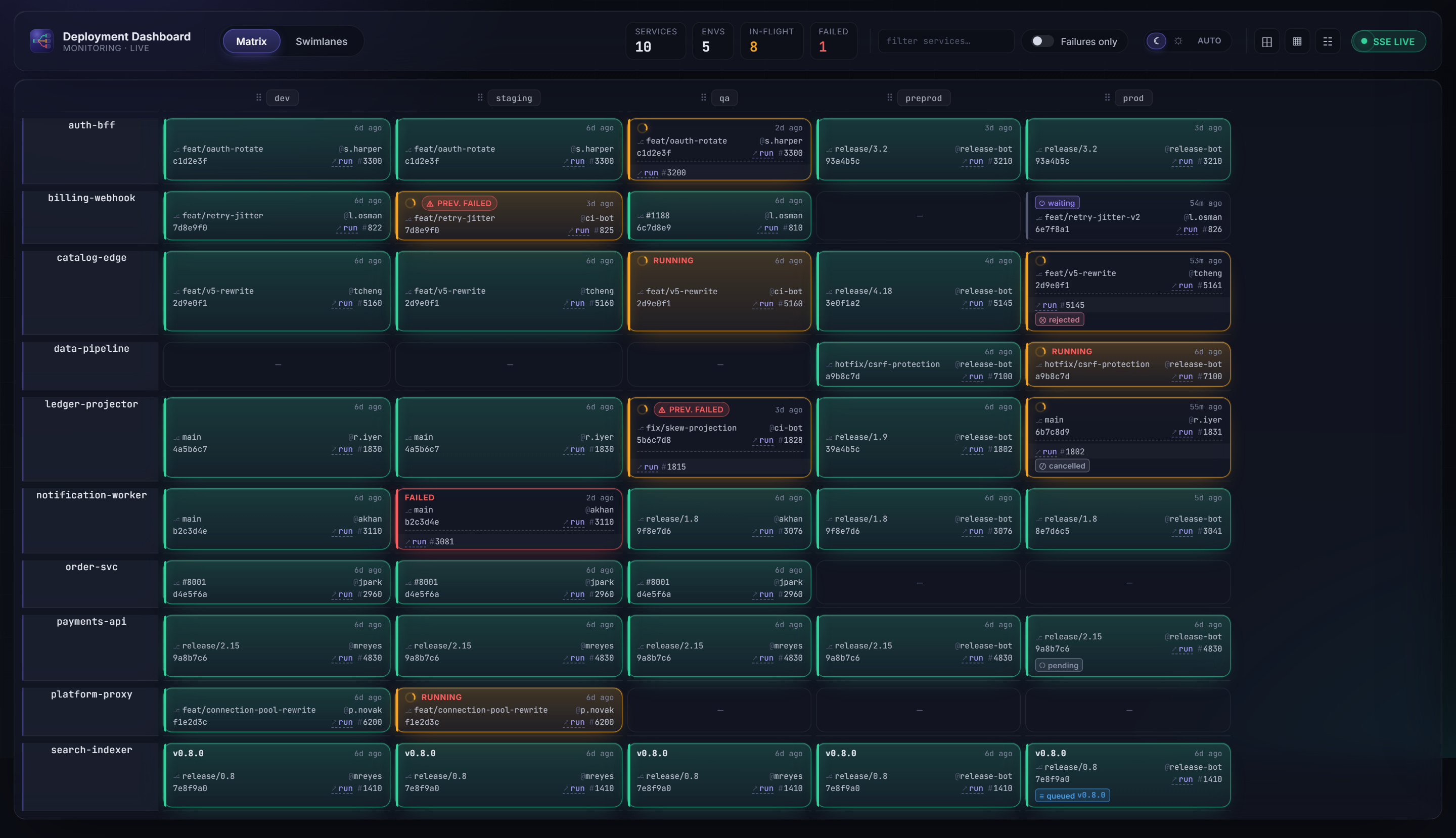
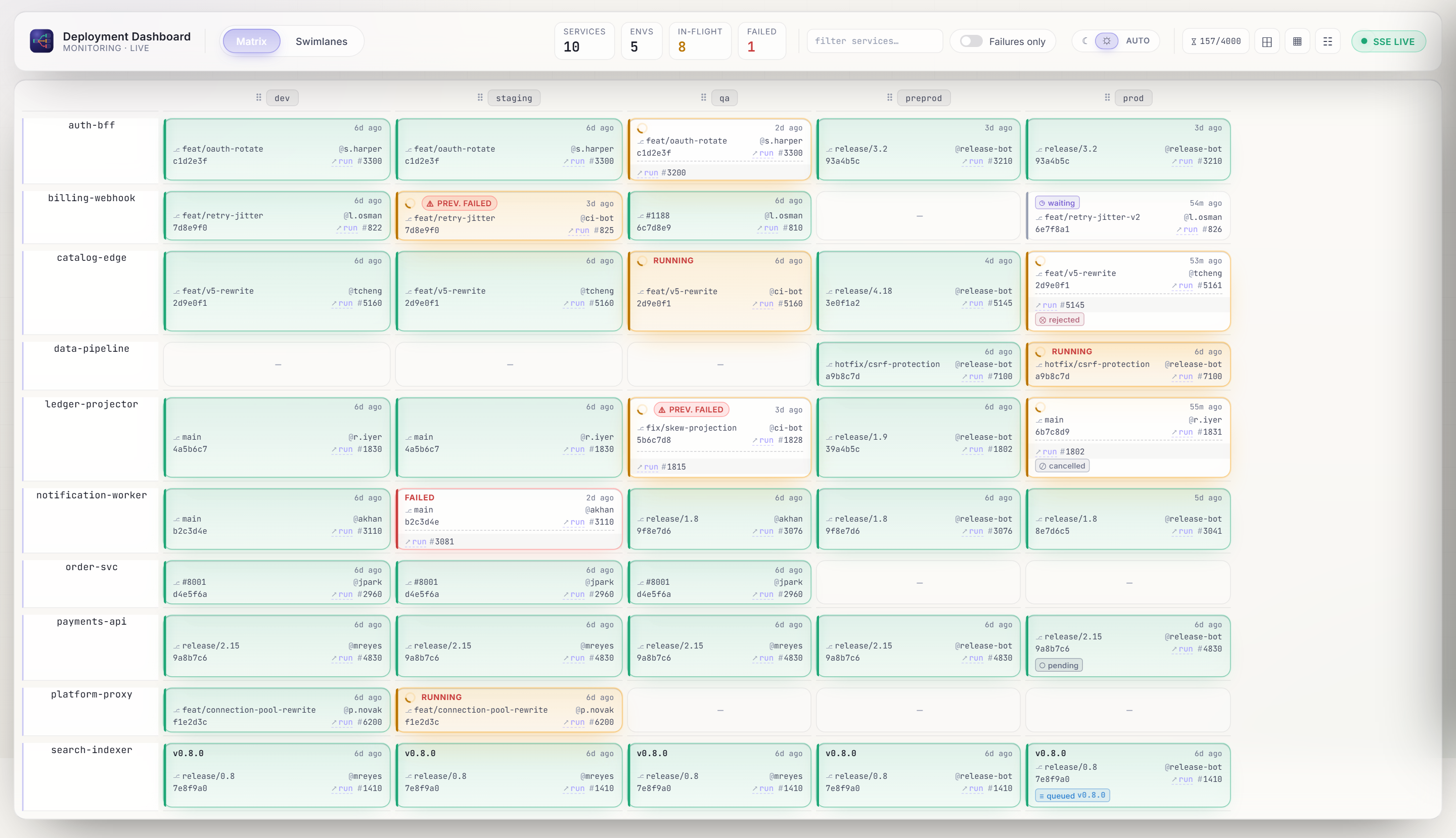
Most "AI coding" stops at snippets a human must then integrate, test, document, and ship. Here, AI owns the whole lifecycle — the human stays minimal. The product here is real — the Deployment Dashboard, a live services × environments matrix sourced straight from CI/CD events.
-
Source code
Backend services, web app, browser extension.
-
SDLC automation
Branching, guardrails, CI/CD, release machinery.
-
Documentation
Architecture, specs, guides — kept current.
-
Testing
Unit, contract, integration, end-to-end.
-
Delivery
Committed & reviewed as pull requests — then cut as GitHub Releases with deployable Docker images.
The human owns only direction and acceptance. Everything in between is the AI team's.
Zero to hero

How it works: judgment + enforcement
Built the way Anthropic recommends building agents — in the team's own terms:
- Orchestrator-workers (hub & spoke) — a lead plus specialist roles.
- Isolated contexts — each specialist works disposably; the lead stays lean.
- Typed protocol — every cross-role hand-off is a schema-checked message.
- Deterministic guardrails — the rules are enforced by programs, not goodwill.
Two layers carry it — judgment decides, enforcement guarantees:
A lead agent orchestrates — it plans the work, routes each slice to the role that owns it, and integrates what comes back. One coordinator, many specialists.

- The lead coordinates, never codes — it dispatches and integrates; it never edits a role's files.
- Roles own lanes — each holds its own non-negotiable bar; parallel only on disjoint files.
- Typed hand-offs —
BRIEFdown;RESULT·REVIEW·FINDING·ARTIFACTup;FIXfor the loop.
Judgment can be argued with; hooks can't — small deterministic programs run at every key moment and block any rule-break. The AI can't talk past them.

Ten such hooks
Each is an independently tested program, wired in at every key moment — session start, before each edit, before each message, before every commit.
What the solution is made of
-
Process & roles
A defined lifecycle — intake → contract → build → review → test → ship — run by an orchestrator + 6 specialist roles.
-
Specialist agents
AI workers for API, backend, frontend, deployment, testing, and documentation.
-
Docs-keeper
Keeps documentation authoritative and current — and blocks any change that lets it drift.
-
Hooks
10 deterministic guards that enforce the rules automatically, every time.
-
Code intelligence
Purpose-built search so agents navigate the codebase fast and cheaply.

The process in action: issue #299
A DORA analytics view — contract to shipped — in ~2.5 hours. A recent, ordinary example: a new analytics tab with the four industry-standard delivery metrics, eight charts, and new server-side endpoints.

- ~6,500 lines across 41 files — API contract, backend, web UI, spec, and full test coverage.
- Self-corrected mid-flight through the review-and-fix loop.
- Stopped at the pull request for human acceptance — the process never auto-merges.
→ See the real thing: issue #299 — the requirements · PR #308 — the implementation
Why it matters
-
Team
One person directing an AI engineering team.
-
Time to market
A working MVP in 3 days; features in hours.
-
Quality
Tests & review enforced by hooks — they can't be skipped.
-
Living docs
Documentation can't silently rot.
-
Reusability
The same process builds the next product too.
-
Control
Humans set direction; AI executes within guardrails.
The takeaway
One person and AI built a shipping product — a half-page idea became a working MVP in 3 days, plus a reusable engineering process that builds the next product too. The breakthrough isn't a smarter model — it's instructions for judgment + hooks for guarantees.
Even this page
This showcase — every word and all five diagrams — was written and drawn by the same Claude team it describes. Meta, but true.